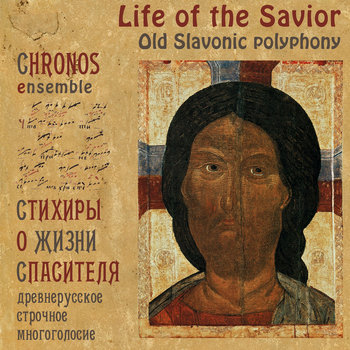
As we celebrate Pascha (Easter) today, I had the good fortune to find this CD. From the Chronos Ensemble Bandcamp site:
“The polyphony emerged in Russia long before its musical culture experienced European influence. Even the earliest survived examples of western polyphony of 10-11 centuries are mostly composed according to the intervallic system with awareness of consonance and dissonance. Later that system brought to life the colors of major and minor, and the modality of a scale was replaced by the tonal functions.The polyphony of Old Russia was linear. This modal system allows any kind of the intervals of diatonic scale which are considered consonances. In the oral tradition of a folk music those voices were improvised by the singers according to the strict rules. In the late 15th century the polyphony appeared in church music. The Old Russian “Znamenny” plainchant was modified into the “Putevoy” (leading-the-way) chant and became the core (cantus firmus) melody for the polyphonic style compositions. In later sources this style is indicated as Troestrochie (three-line). The main melody is called ”Way” (Put), and 2 others – “upper” and “lower” . The lower voice is the most melismatic and the upper voice has a very expressive rhythmic structure. The leading voice is rather stable and slow. In the time of Ivan the Terrible – late 16 century, when the neumatic notation was improved and the tradition of professional singing flourished, vocal scores often have all three voices realized in writing. In 17th century a lot of musical scores were written in European Kiev-notation.Apart from “Strochnoy” chant there also existed a 4-part “Demestvenny” chant. The cantus firmus of this chant has its own system of musical phrases which makes it different from znamenny-putevoy chant.”